Introduction
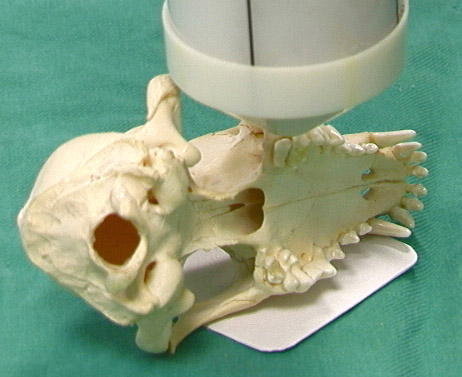
This technique is an alternative to the bisecting angle technique,
for the maxillary cheek teeth. It is of particular use in cats,
where the zygomatic arch superimposes over standard intra-oral bisecting
angle views.
Principle
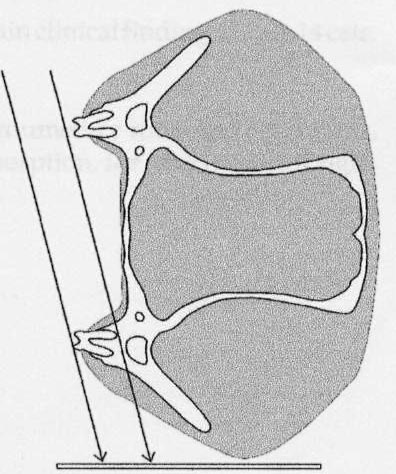
The patient is in lateral recumbency, with the target teeth nearest
the table. The long axis of the target teeth is as near parallel
to the film as possible and the beam is angled at approximately
70 degrees to the film and the target. The mouth is opened, with
a prop, to direct the beam onto the film without superimposing the
top cheek teeth on the bottom cheek teeth.
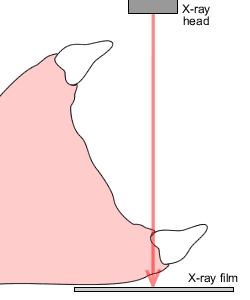 EOP position for dogs
 |
|
|
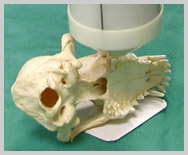
Extra -oral near parallel technique for caudal maxillary cheek
teeth
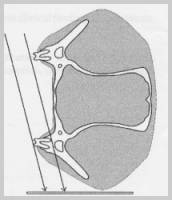
Extra -oral near parallel technique for
caudal maxillary cheek teeth. Useful for cats to prevent superimposition
of the zygomatic arch
Diagram courtesy of Dr FJ Verstraete, University of California,
Davis
|