Introduction
Digital radiography is currently available to most practices with
their current technology - scanners and/or digital cameras.
The advantage of digital images is that they can be manipulated
on the computer screen to aid diagnosis by changing density, contrast
and magnification. These images can also be easily stored and used
for client education, referral opinions or letters, etc. The digital
files are easily transferred from computer to computer both by disk
and via the Internet.
There are four ways that radiographs can be converted to digital
images.
|
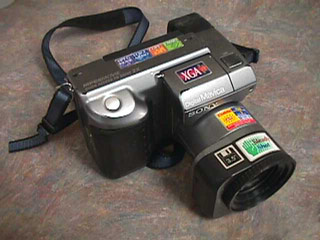
Digital Cameras
Digital photography is a cost effective method of converting
conventional radiographs to digital images. The radiograph
is placed on a view box or window looking into blue sky and
the photograph is taken.
It can then be transferred to a computer for editing and
storage. Generally, the digital image should be converted
to black and white format to avoid discoloration caused by
artificial lights.
Digital photography and scanning (depending on the cost of
the scanner or camera) are the least expensive methods of
obtaining digital radiographs.
|
|
Sony Mavica digital camera
|
Scanning
This method requires a scanner hooked up to a computer. The scanner
must be able to "backlight" the radiograph.
Phosphorus Sensor
This technique utilises an image plate which can be reused. The
size of the plate can vary from small periapical films to larger
panoramic sizes. After exposure with a conventional dental radiographic
unit, the plate is placed in a scanner and transmitted to a computer.
The image can be manipulated, is easily transferred, and has less
radiation per image than conventional radiology. The disadvantages
are that the image is not instant and must be scanned to view. It
requires more steps than CCD/CMOS technology. Initial cost is in
the range of £5,000 to £10,000.
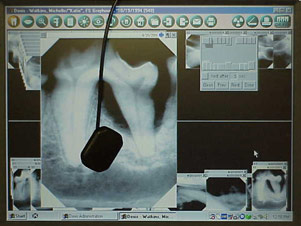
CCD/CMOS Sensor
This technique uses a sensor plate attached to a computer.
The advantage is that the image is immediately displayed on
the computer. The disadvantage is that the sensors are expensive
and, at this time, only come in periapical film size 2.
|
|
Digital radiographs and CCD/CMOS
sensor plate
|
|