|
Haemorrhage can be from bone or soft tissue.
|
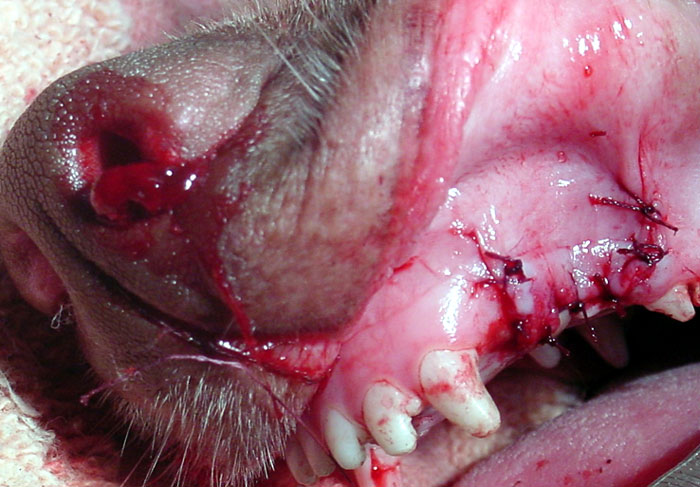
Profuse haemorrhage from left nostril
following "difficult" extraction of the left upper
canine tooth
Photo courtesy of Dr Robert Wiggs, Dallas
Dental Service for Animals, Dallas, Texas, USA
|
Most sockets stop bleeding quickly post extraction with little
need for attention beyond gentle pressure, a cold pack or ligation
of obvious bleeders and suturing of the surrounding gingiva.
Packing socket with polylactic acid cubes (ADD™) or Bioglass
(Consil™) can be expensive but has the added advantage of both
obturation of the void and alveolar ridge maintenance.
Haemostatic gauze or pellets may also help, but may have to be
removed after a short period (e.g. Kaltostat™).
Electrocautery needs great care. Fulguration (sparking) mode can
be used for bone haemorrhage, as can crushing with ronguers or packing
with sterile Bone Wax™ (Ethicon). Be aware of the problems
of leaving foreign antigenic material buried under a flap.
Beware dogs with clotting factor defects (e.g. Von Willebrand's).
Pre-test clotting factors to assess suitability for surgery and
hospitalise overnight if required.
|