Extraction chapter
Help Main Menu

<<Prev

Regional Blocks

Next>>

Dental local anaesthetic syringe


Two main sensory nerves supply the teeth and jaws - infra-orbital and inferior mandibular nerves. Pre-operative regional nerve blocks on these nerves greatly assists comfort and reduces the need for powerful analgesia during and immediately after surgery.

Mepivicaine or, preferably, bupivicaine can be used. Bupivicaine 0.5% will provide around 6 hours analgesia for soft tissues and 1.5 to 3 hours for dental pulp. The onset time is 6 minutes. Mepivicaine will provide less time. Mepivicaine HCl (Scandonest™ 3% plain) is supplied as 2.2ml pre-filled cartridges and is used with a dental syringe and 27g x 35mm needles. The dose is 0.25ml to 0.5ml for cats and 0.25 to 1ml for dogs depending on size.


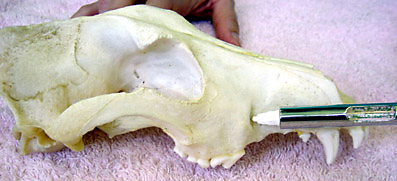
Local regional blocking of maxillary teeth  

This photograph illustrates the correct technique for local regional blocking of maxillary teeth. The needle should be placed at least 20mm into the infraorbital canal. The agent should be deposited as the needle withdraws.


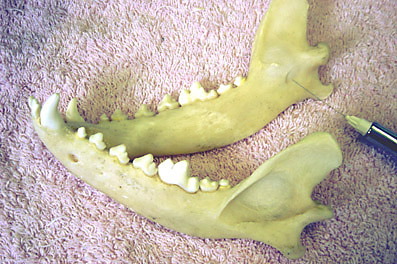
Extra-oral regional blocking of the mandibular teeth  

This photograph illustrates the correct technique for extra-oral regional blocking of the mandibular teeth. The foramen can be palpated on the medial surface of the coronoid process and the agent injected at the entrance. This extra-oral technique can be challenging due to the convex nature of the bone surface.


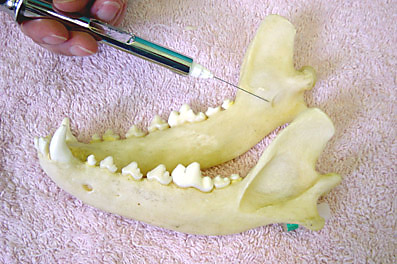
Intra-oral regional blocking of the mandibular teeth  

This photograph illustrates the correct technique for intra-oral regional blocking of the mandibular teeth. The foramen can be palpated half way between the last (3rd) molar and the angular process. The needle is directed with the forefinger and the agent injected at the entrance. This technique is easier than the extra-oral approach and less likely to affect adjacent nerves (e.g. hypoglossal).


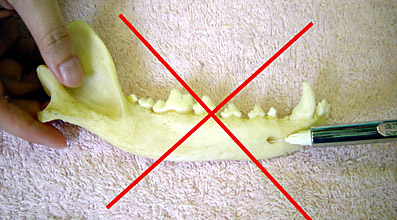
Ineffective blocking technique for teeth  

The technique illustrated in this photograph will be ineffective for teeth. If the agent is placed in the middle mental foramen only the rostral mandibular soft tissue will be effectively anaesthetised.


The infraorbital nerve is sensory to the maxillary teeth via the caudal, middle and rostral superior alveolar nerves. These branches leave the main nerve trunk before it leaves the infraorbital canal. For a regional block to be successful the needle must enter the canal by 20-32 mm, depending on dog size, before depositing the local anaesthetic. Once the nerve leaves the infraorbital canal it is sensory only to the upper lip and nose.

The inferior alveolar nerve innervates the mandibular teeth. All the branches to the teeth have left the main trunk before it emerges from the three mental foramina. The only effective method is to deposit local anaesthetic at the foramen on the lingual aspect of the caudal mandible where the nerve enters the bone. This requires either an intra-oral approach or a ventral approach. The intra-oral approach is preferred as it allows greater accuracy.

The mandibular foramen is half way along a line between the crown on the last (third) molar and the angle of the mandible. Position the needle at the opening of the foramen and deposit the dose whilst securing the needle with a finger. The operator must be aware of two other branches of the mandibular nerve close to the injection site - lingual and myelohyoid. Accidental anaesthesia of these nerves will desensitise the tongue - possibly with disastrous consequences.

If purchasing a dental syringe (not necessary), ensure that it allows "draw-back" into the ampoule if performing regional blocks into areas where iatrogenic venepuncture is possible, such as the infra-orbital canal (Verstraete, 2000).


<<Prev

© 2002 eMedia Unit RVC v1.0

Next>>


Printable chapter
(PDF format)