
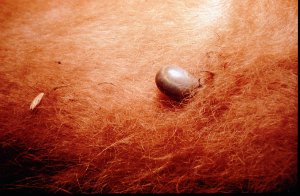
Ixodes ricinus fed female
This is a female Ixodes ricinus tick that is feeding on a cow. She will soon drop off the animal and lay her eggs . If the animal was infected with Babesia divergens then the parasite will undergo development in the tick before she drops off and the protozoan will pass to the eggs which will in turn give rise to Babesia-infected larval tick.When the the larval tick feeds it will pass on the infection to that host (transovarial transmission). The infected larva also retains the infection in its tissues so that the next stage in the life cycle (nymph) is also capable of transmitting the protozoan when it starts to feed (transtadial transmission). Similarly, the the adult stage also acquires an infection from the nymph and transmits the infection during feeding.
See also