In the cells of aerobic organisms that contain mitochondria, oxidative phosphorylation provides the bulk of the need for ATP. This depends on a chemiosmotic process which creates an electrochemical proton gradient across the mitochondrial inner membrane. The gradient is maintained by redox reactions which terminate with the use of oxygen as the final electron acceptor.
Aerobic Respiration is the process that these living organisms use to obtain energy, through a sequence of enzyme catalyzed reactions where nutrient molecules are oxidised and the free energy released is harnessed as ATP.
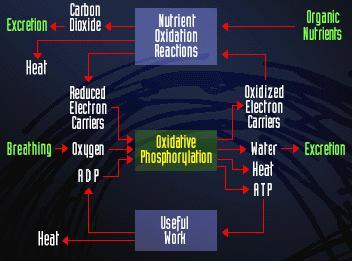
The scheme below depicts an overview of aerobic metabolism.
In the process of oxidative phosphorylation ATP is generated by dissipation of a transmembrane electrochemical proton gradient established across the mitochondrial inner membrane.
The gradient itself is established by re-oxidation of the nicotinamide and flavin intermediary electron carriers which become reduced when carbon substrates are oxidised.
Oxygen is used as the ultimate electron acceptor, becoming reduced to form water.
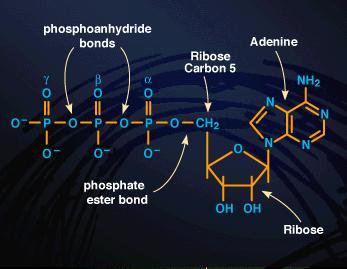
Adenosine triphosphate (ATP) is a source of free energy synthesized in association with the oxidative catabolism of nutrient chemicals in heterotrophic organisms.
Cleavage of its phosphoanhydride bonds supplies free energy to drive metabolic processes such as biosynthetic reactions and the active transport of metabolites and ions across membranes. These functions are described as useful work.
The different parts of ATP are illustrated below.
Some life forms live under anaerobic conditions: they do not require molecular oxygen to be available as an electron acceptor for ATP synthesis.
If oxygen is not present ATP is generated either by Fermentation or
Anaerobic Respiration.